
Monitoring & Observability
You can’t operate a distributed system you can’t see. Monitoring and observability are how you go from “the user filed a ticket” to “we paged ourselves about it 90 seconds before the user noticed” — and that’s the bar you should aim for in any interview answer involving real-world operability.
The terms get conflated, so let’s separate them.
Monitoring vs observability
Section titled “Monitoring vs observability”Monitoring is the practice of collecting predefined signals (CPU, requests/sec, error rate, queue depth) and alerting when they cross thresholds. You know what to look for.
Observability is the property of being able to answer new questions about your system without shipping new code. It’s about having enough detail in your data — high-cardinality metrics, structured logs, distributed traces — that you can drill into a novel problem post-hoc.
Most teams have basic monitoring (dashboards, alerts). Fewer have real observability. In an interview, “we’ll have monitoring” is a checkbox; “we’ll instrument enough to debug unknown unknowns” is the senior version.
The three pillars
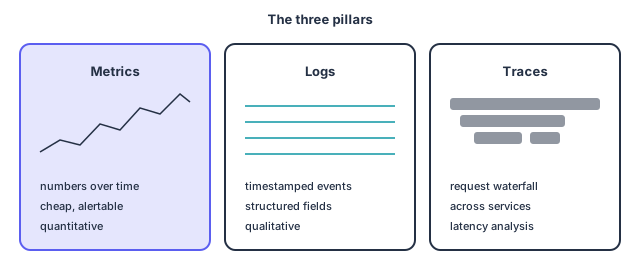
Section titled “The three pillars”The conventional framing — useful even if a little reductive.
Metrics. Numbers over time. Cheap to store, cheap to query, easy to alert on. Best for quantitative questions: how many requests, how fast, how often errors. Examples: Prometheus, Datadog metrics, CloudWatch metrics.
Logs. Textual events with timestamps. Best for qualitative questions: what exactly happened in this request. Structured logs (JSON with consistent fields) are dramatically more useful than free-text. Examples: Elasticsearch/OpenSearch, Loki, Splunk, CloudWatch Logs.
Traces. End-to-end views of a single request as it travels through multiple services. Best for latency and dependency questions: which downstream service is slow, which dependency timed out, which path is the critical path. Examples: Jaeger, Zipkin, OpenTelemetry-based traces in Datadog/Honeycomb.
Modern best practice is to instrument with OpenTelemetry (vendor-neutral SDKs and protocols) and ship to whichever backends you prefer. Mentioning OpenTelemetry is enough to signal currency.
The four golden signals
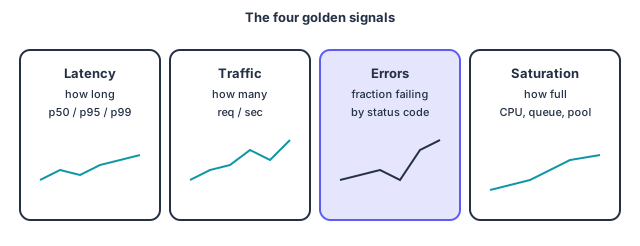
Section titled “The four golden signals”Originally Google SRE’s framing for what to monitor on every service. Memorize:
- Latency — how long requests take. Track p50, p95, p99 separately (averages lie).
- Traffic — how many requests, per second.
- Errors — fraction of requests failing, by status code.
- Saturation — how full the system is (CPU, memory, queue depth, connection pool).
If you can dashboard those four for every service, you’ve covered 90% of operational visibility. RED (Rate, Errors, Duration) and USE (Utilization, Saturation, Errors) are similar acronyms describing the same idea from slightly different angles.
Percentiles, not averages
Section titled “Percentiles, not averages”This is one of the single most important habits to internalize. Averages hide everything that matters.
A service with a 100ms average latency might have a 50ms median and a 2-second p99. The average and the median are fine; the p99 means 1% of users wait two seconds. At a million requests, that’s 10,000 unhappy users per query period.
Rules of thumb worth quoting in an interview:
- Always alert on p99 or p99.9, not p50 or average.
- Latency budgets are end-to-end. A 200ms p99 budget can’t be met if you have ten serial downstream calls each at 50ms p99 — the tail amplifies.
- Slowest links dominate. Tail latency is set by your worst replica, not your average one.
SLIs, SLOs, and error budgets
Section titled “SLIs, SLOs, and error budgets”A more disciplined frame:
- SLI (service-level indicator). A measurable property of the service. “Fraction of requests returning within 200ms.”
- SLO (service-level objective). A target value for the SLI. “99% of requests within 200ms over a rolling 30 days.”
- Error budget. The complement of the SLO. “We’re allowed to fail 1% of requests; how much have we burned?”
The point of an error budget isn’t compliance — it’s a forcing function for prioritization. If you’ve burned 80% of the budget two weeks into the month, the team focuses on reliability over features. If you’ve burned 5%, the team is free to ship riskier work.
In an interview, naming an SLO is much more impressive than saying “high availability.” Saying “99.95% of writes succeed within 1 second, measured at the gateway, over a rolling 28-day window” sounds like an engineer who has owned a production service.
High-cardinality data: where observability lives
Section titled “High-cardinality data: where observability lives”The reason “metrics, logs, traces” isn’t sufficient on its own is that metrics traditionally roll up to low cardinality (a few tags) for cost reasons. You can ask “how many errors?” — you can’t always ask “how many errors for users on Android 12 in São Paulo?”
The newer wave of observability tools (Honeycomb is the iconic example; Datadog and others follow) keeps wide events — every request becomes a row of dozens or hundreds of attributes — and queries across them at high cardinality. That’s how you debug “why are exactly these 17 users failing?”
You don’t need to use any specific product. You need to structure your logs and traces with enough dimensions to answer questions you didn’t anticipate. Things like user_id, request_id, deployment_version, region, feature_flag — add them as fields, not by parsing free text.
Distributed tracing in one paragraph
Section titled “Distributed tracing in one paragraph”Each incoming request gets a unique trace ID, propagated through every downstream call. Each service emits a span describing the work it did, parent-linked to the calling span. The collection of spans for one trace ID reconstructs the request’s path through the system. You can then see, in a flame graph, which span is the slow one.
This is the only practical way to debug latency in a microservices system. Without it, you’re guessing.
Two practical notes:
- Sample. Tracing every request is expensive. Tail-based sampling (keep all spans for slow or errored requests, sample the rest) is the modern approach.
- Propagate trace context. Use W3C
traceparentheaders. Everything else is bespoke and brittle.
Alerts: the part everyone gets wrong
Section titled “Alerts: the part everyone gets wrong”The two biggest alerting mistakes:
- Alerting on causes, not symptoms. You don’t care that CPU is 90%; you care that latency is bad and errors are up. Alert on the user-facing symptom; investigate the cause from there.
- Too many alerts. Every false alarm trains the on-call to ignore alerts. Aim for every alert is actionable. If an alert fires and the answer is “wait, it’ll clear up,” delete the alert.
A widely used heuristic: alerting should be SLO-burn-rate based. Page when you’re going to miss the SLO; don’t page on every threshold cross. Google SRE’s “Alerting on SLOs” chapter is the canonical reference.
What to instrument first
Section titled “What to instrument first”If you’re building a new service, in order:
- The four golden signals, exposed as Prometheus-style metrics.
- Structured logs, with request_id, user_id, route, status, latency, error message.
- Distributed tracing, propagating W3C trace context.
- A health endpoint for liveness/readiness probes.
- An alerting plan tied to SLOs, not raw thresholds.
- A dashboard per service displaying the four signals over the last hour.
Mention as many of these as fit the prompt. Six bullets is too many; pick the two or three the interviewer most wants to hear.
Common pitfalls
Section titled “Common pitfalls”Alert spam. Page fatigue is a real outage cause. Tune ruthlessly.
Metrics without context. A graph that says “errors are up” with no way to know which endpoint, which version, which user segment — useless during an incident. Tag your metrics.
Logs as your primary debugging tool. Logs are essential, but searching them as your default tool means every incident is a 30-minute archaeology session. Metrics for “what’s wrong” + traces for “where” + logs for “exactly what” is the modern split.
No way to test instrumentation. If you haven’t run a fire drill, your monitoring probably doesn’t work the way you think. Run synthetic incidents periodically.
What to say in an interview
Section titled “What to say in an interview”A clean observability paragraph:
“Every service emits the four golden signals as Prometheus metrics — latency p50/p95/p99, traffic, errors, and saturation. Logs are structured JSON with request_id and user_id on every line. We use OpenTelemetry for distributed tracing with tail-based sampling at 1% of normal traffic and 100% of slow or errored requests. SLO is 99.95% of writes succeed in under 1 second over a 28-day window, and we alert on burn rate — pages fire when we’re going to miss the SLO, not on every spike. Every alert has a runbook.”_
Eight specific decisions in five sentences. That’s how observability is graded.