
SQL vs NoSQL
The “SQL vs NoSQL” question is unavoidable in system design interviews, and most candidates answer it badly — usually by mentioning “scale” without specifying what scale means or why one side of the divide handles it better. The honest version is: relational and non-relational databases solve different problems, and modern systems often use both.
What “SQL” really means
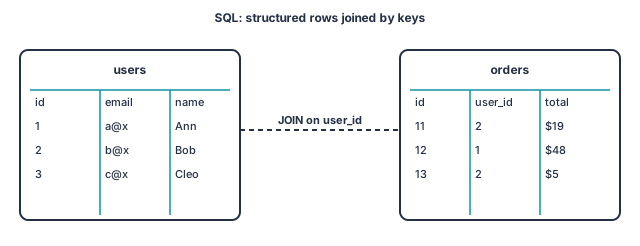
Section titled “What “SQL” really means”A SQL (relational) database stores data in tables of rows and columns, with a fixed schema, strong ACID guarantees, and a rich query language. Examples: PostgreSQL, MySQL, Oracle, SQL Server, plus distributed variants like CockroachDB, Spanner, YugabyteDB.
What you actually get:
- ACID transactions — Atomicity, Consistency, Isolation, Durability across multiple rows and tables.
- Joins — combine data from multiple tables in a single query.
- Strict schemas — every row in a table has the same columns and types.
- Mature tooling — query optimizers, replication, backups, observability.
What it costs:
- Vertical scaling first. Traditional single-leader Postgres maxes out around 50–100k QPS on a beefy box; you scale by sharding (manually or with extensions like Citus) or moving to a distributed SQL engine.
- Schema changes are expensive at large table sizes. Adding a column to a billion-row table without an outage takes planning.
- Write throughput is the usual bottleneck. Replicas help reads, not writes.
What “NoSQL” really means
Section titled “What “NoSQL” really means”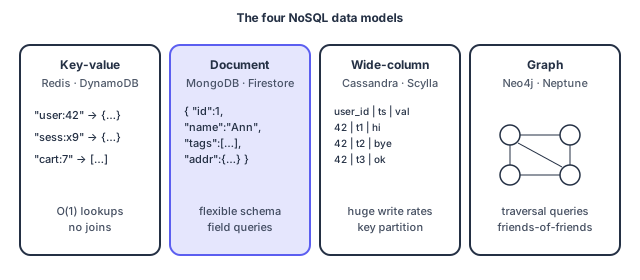
“NoSQL” is a four-way bucket of fundamentally different data models:
- Key-value (Redis, Memcached, DynamoDB, etcd). Just a giant distributed hash map. The simplest model and often the fastest.
- Document (MongoDB, Couchbase, Firestore). JSON-shaped documents, flexible schema, queries by field.
- Wide-column (Cassandra, ScyllaDB, HBase, Bigtable). Tables with rows and dynamic columns; queries are designed around a known partition key.
- Graph (Neo4j, JanusGraph, Amazon Neptune). Nodes and edges, queried via traversal languages like Cypher or Gremlin.
What you typically get across the family:
- Horizontal scaling as a primary feature. Partitioning is built in; adding nodes increases capacity linearly within limits.
- Flexible schemas. You can evolve the shape of stored data without a migration step.
- Predictable, low-latency single-key access — orders of magnitude faster than complex SQL for the same simple lookup.
What it costs:
- Weaker transactional guarantees. Most NoSQL stores offer single-key atomicity but not multi-key or cross-table transactions (some now offer them, but at a latency cost).
- No joins. You denormalize at write time or join in the application.
- Query patterns must be known up front. Cassandra in particular is designed around access patterns, not the data shape.
- Operational complexity. Tuning, repairs, compactions, and partition design are all your job.
The actual decision
Section titled “The actual decision”Forget “scale.” Make the decision on the access pattern and the consistency requirements.
Reach for SQL when:
- You have many entity types with relationships you’ll want to query across (orders, users, products, payments).
- You need transactions spanning multiple rows or tables.
- Access patterns will evolve and you don’t want to predetermine queries.
- Strong consistency is non-negotiable somewhere in the system.
Reach for NoSQL when:
- Access is overwhelmingly single-key or single-partition lookups.
- Write throughput exceeds what a single SQL leader can handle (~50–100k writes/sec).
- The data model is genuinely document- or graph-shaped, and forcing it into rows would be painful.
- You’d rather denormalize at write time than join at read time.
In real systems you frequently use both: a SQL store as the system of record + a NoSQL store as a read-optimized cache or denormalized view.
Concrete patterns by domain
Section titled “Concrete patterns by domain”E-commerce checkout — SQL. Money, inventory, ACID. Don’t be clever.
Product catalog reads at 100k QPS — Postgres as source of truth + Redis or DynamoDB as a cached read layer.
Activity feeds and timelines — wide-column (Cassandra, ScyllaDB). Append-only writes, key by user, time-ordered. A canonical fit.
User session store — key-value (Redis). Tiny payloads, microsecond reads, TTL-based expiry.
Social graph — graph database for traversal queries (friends-of-friends), often layered with denormalized lookup tables for hot paths.
Real-time analytics / logs — columnar (ClickHouse, BigQuery, Druid), which is a third category outside the SQL/NoSQL binary but worth knowing exists.
”Modern” complications
Section titled “”Modern” complications”A few things worth knowing because interviewers do bring them up:
- NewSQL / distributed SQL. CockroachDB, Spanner, YugabyteDB, Vitess. SQL semantics with horizontal scale via Paxos/Raft and sharded storage. Higher write latency than single-leader SQL; better than NoSQL for transactional workloads at scale.
- NoSQL with transactions. DynamoDB Transactions, MongoDB multi-document transactions, FoundationDB. Real but with cost — usually higher latency and limited scope.
- Multi-model databases. Cosmos DB, ArangoDB, Couchbase. One engine, multiple data models. Convenient operationally; rarely the best fit for any single workload.
Common interview pitfalls
Section titled “Common interview pitfalls”Picking NoSQL “for scale” on a moderate workload. Postgres on a single beefy machine plus read replicas handles enormous traffic. Justify NoSQL with an actual number.
Picking SQL because it’s familiar. If the access pattern is “give me everything for user 42,” a key-value store is dramatically simpler and faster.
Forgetting the consistency story. Whichever you pick, name the consistency level. See CAP Theorem.
Treating the choice as monolithic. Real systems use multiple stores, each for its strength.
What to say in an interview
Section titled “What to say in an interview”A confident one-liner that earns credit:
“The source of truth is Postgres — we have transactions across users, orders, and payments. Read-heavy lookups (product detail, session, feature flags) are served from Redis with cache-aside. The activity feed lives in Cassandra because writes go straight to a user-keyed timeline and we never need cross-user joins on it.”
Three stores, three reasons, each tied to an access pattern. That is the bar.