
CAP Theorem & Trade-offs
The CAP theorem is the most misquoted idea in distributed systems. Used carelessly, it sounds like a horoscope (“pick two of three”). Used carefully, it gives you a precise vocabulary for the trade-offs you’ll defend in nearly every system design interview.
The theorem, stated precisely
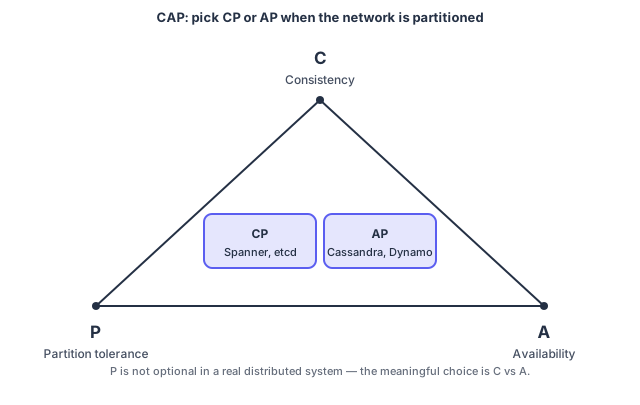
Section titled “The theorem, stated precisely”Eric Brewer’s CAP theorem says that a distributed data store can, in the presence of a network partition, provide at most one of:
- C — Consistency: every read sees the latest committed write.
- A — Availability: every request receives a non-error response (though possibly stale).
The third letter, P — Partition tolerance, is not really optional in any real distributed system — networks fail, packets drop. So the meaningful choice is between CP (consistent under partition, but reject some requests) and AP (available under partition, but allow stale or conflicting reads).
A single-node database is “CA” in a trivial sense — there’s no partition because there’s only one node. The interesting CAP discussion only starts once data lives on more than one machine.
CP vs AP, in plain terms
Section titled “CP vs AP, in plain terms”CP systems would rather return an error than return wrong data. When a partition splits the cluster, the minority side stops accepting writes (and often reads too).
- Examples: Spanner, CockroachDB, etcd, ZooKeeper, HBase.
- Use when: money, inventory, configuration, leader election, anything where wrong > slow > down is not acceptable.
AP systems would rather keep serving requests than refuse them, accepting that some replicas may diverge and need reconciliation later.
- Examples: Cassandra, DynamoDB (in default mode), Riak, most CDNs and DNS resolvers.
- Use when: social feeds, analytics, view counts, shopping carts, anything where stale > down.
A quick test: if your business answer to “the system is partitioned — should we serve stale reads or refuse?” is “serve stale,” you want AP. If it is “refuse,” you want CP.
PACELC: the more honest version
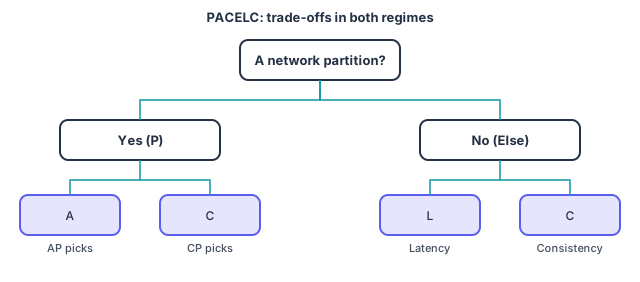
Section titled “PACELC: the more honest version”CAP only talks about partitions. PACELC (Daniel Abadi) extends it: if there is a Partition, choose A or C; else, choose L (latency) or C (consistency).
That second half is the one that matters most days. Even in healthy operation, strong consistency over multiple replicas costs you latency — you have to wait for a quorum, often across availability zones or regions. So a more useful framing is:
- PA/EL — Cassandra, Dynamo, most caches: prefer availability under partition, prefer latency in normal operation.
- PC/EC — Spanner, CockroachDB, HBase: prefer consistency under partition, prefer consistency in normal operation.
Most production systems are not pure picks. You compose them: a strongly-consistent metadata store (PC/EC) in front of an eventually-consistent bulk store (PA/EL).
Consistency models worth naming
Section titled “Consistency models worth naming”“Strong” and “eventual” are too coarse for a senior interview. Reach for these when relevant:
- Linearizable / strong consistency — all clients see operations in a single global order; reads return the latest write. Expensive but simple to reason about.
- Sequential consistency — operations appear in some total order consistent with each client’s program order. Weaker than linearizable; the global “real time” is not respected.
- Causal consistency — operations causally related are seen in the same order by everyone; concurrent operations may be seen in different orders. A good middle ground for chats and collaborative editing.
- Read-your-writes — a single client always sees its own writes. Crucial for UX (no “did my post save?” loop).
- Monotonic reads — once a client has seen a value, it never sees an older one.
- Eventual consistency — replicas converge if writes stop; no other guarantees.
Naming the specific guarantee earns more credit than saying “we’ll use strong consistency” everywhere.
Latency vs throughput vs durability
Section titled “Latency vs throughput vs durability”CAP isn’t the only set of trade-offs. The other big ones:
Latency vs throughput. Batching, async work, and queues raise throughput at the cost of latency. For most user-facing reads you want low latency; for analytics or fan-out you want throughput.
Latency vs durability. Synchronous replication to N replicas costs you the slowest replica’s latency on every write. Async replication is faster but loses some writes if the leader dies. Quorum (N/2 + 1) is the standard middle ground.
Cost vs everything. Stronger guarantees and tighter latencies almost always cost more — more replicas, more nodes, more cross-region traffic. Be willing to say “this configuration meets our SLO at roughly 2x the cost of the cheaper option.”
How to use this in an interview
Section titled “How to use this in an interview”You don’t need to recite CAP. You need to make the trade-off explicit at the point of decision:
“I’ll use a CP store for the payments ledger — we’d rather refuse a transaction than double-charge. The product catalog can be AP because stale price data for a few seconds is acceptable, and we want it to stay available during a regional partition.”
Two sentences, two systems, two correctly-applied trade-offs. That is the bar.
Common pitfalls
Section titled “Common pitfalls”- Treating CAP as “pick two of three.” P isn’t really optional. The choice is C vs A given a partition.
- Calling everything “eventually consistent” without specifying the convergence window. “Eventually” without a number is a hand-wave.
- Forgetting that consistency costs latency even without partitions. PACELC is the half most candidates miss.
- Designing one consistency model for the whole system. Real systems mix strong and eventual paths intentionally.
If you can say which letter your store picks and why the product allows it, you sound like an engineer who has lived inside these trade-offs — which is the entire point.