
Interview Framework
The single most important habit you can build is a repeatable structure for the interview itself. The framework below works for almost any prompt — URL shortener, news feed, ride-sharing, video streaming, real-time chat. Internalize it until it feels automatic, and you free up your cognitive budget for the actual design.
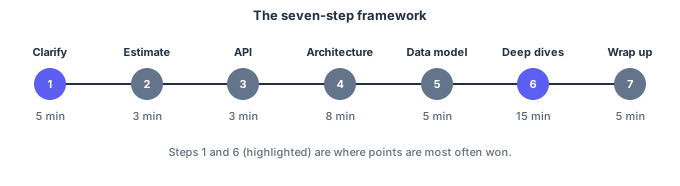
The seven steps
Section titled “The seven steps”For a 45-minute interview, target these timings:
| Step | Time | Goal |
|---|---|---|
| 1. Clarify requirements | 5 min | Pin down what to build and what not to build |
| 2. Back-of-the-envelope estimation | 3 min | Establish scale (QPS, storage, bandwidth) |
| 3. API design | 3 min | Define the public interface |
| 4. High-level architecture | 8 min | Draw the boxes and arrows |
| 5. Data model | 5 min | Schema, keys, access patterns |
| 6. Deep dives | 15 min | Drill into bottlenecks the interviewer steers you toward |
| 7. Wrap up | 5 min | Trade-offs, failure modes, what changes at 10x |
You will almost never hit these times perfectly. Treat them as guardrails: if you are 15 minutes in and haven’t drawn a box, slow down on requirements; if you are 30 minutes in and still on the API, accelerate.
Step 1 — Clarify requirements
Section titled “Step 1 — Clarify requirements”Split into functional and non-functional:
- Functional: what does the system do? “Users post short messages, follow other users, see a feed of posts from people they follow.”
- Non-functional: how does it have to behave? Scale (DAU, QPS), latency (p99 < 200ms), availability (99.9% vs 99.99%), consistency expectations, regulatory or geographic constraints.
Always ask the interviewer; do not assume. Good questions: “How many daily active users? Read-heavy or write-heavy? Should the feed be strictly chronological or ranked? Do we need to support media uploads?”
Pitfall: trying to handle every possible feature. Pick the core functionality and explicitly defer the rest (“I’ll skip notifications and search for now — happy to come back to them if there’s time”).
Step 2 — Estimation
Section titled “Step 2 — Estimation”Quick math, out loud. The full toolbox is in Back-of-the-Envelope Estimation, but in the moment you need three numbers:
- QPS (queries per second), broken down read vs write.
- Storage per year (rows × size × growth).
- Bandwidth (especially if media or video is involved).
The numbers don’t need to be exact — they need to be defensible. “100M DAU, each posts on average twice a day, so ~2.3k writes/sec; reads are roughly 100x that at 230k/sec” is plenty.
Step 3 — API design
Section titled “Step 3 — API design”Sketch 3–5 endpoints that cover the core flows. For each, name the HTTP method, the path, the request parameters or body, and the response. Keep it tight — something like this for a simple social feed:
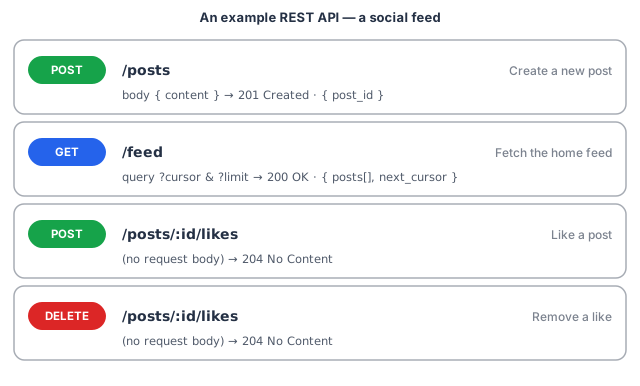
Notice the small design decisions worth saying out loud: the feed is cursor-paginated rather than offset-paginated (offsets drift when new posts arrive), and like and unlike are a POST/DELETE pair on the same resource path rather than two unrelated verbs. Small, consistent choices like these signal that you think in terms of REST resources, not ad-hoc RPC calls.
This is also where you decide between REST, gRPC, or GraphQL — usually REST unless you have a reason. The Communication Protocols page goes deeper.
Step 4 — High-level architecture
Section titled “Step 4 — High-level architecture”Now you draw boxes. A reasonable starting template:
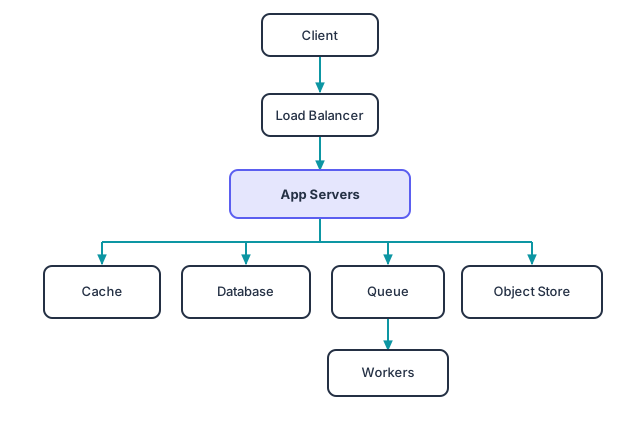
Walk through a write and a read end-to-end. Name the technology you’d pick at each box and one reason (“Postgres because we need transactions on follow relationships; Redis for the timeline cache because it supports sorted sets natively”).
Pitfall: prematurely sharding, queueing, or microservicing. Start simple, then justify each piece of complexity by pointing back to your estimation numbers.
Step 5 — Data model
Section titled “Step 5 — Data model”Show the key tables or document shapes, the primary keys, and the most important indexes. Tie each one to an access pattern from step 1:
“
postsis sharded byuser_idbecause the dominant read is ‘last N posts by a given user’. The feed cache is keyed by viewer_id, populated via fan-out-on-write — see Sharding for why I’m choosing that over fan-out-on-read.”
Step 6 — Deep dives
Section titled “Step 6 — Deep dives”This is where points are won or lost. The interviewer will pick one or two areas and push: “How do you handle a celebrity user with 50M followers?” “What if the cache goes down?” “How do you prevent duplicate posts on retry?”
Treat each deep dive as a mini design exercise:
- Restate the problem.
- Identify two or three approaches.
- Pick one and explain the trade-off.
- Mention failure modes.
Common deep-dive topics: hot keys, the thundering herd on cache rebuild, exactly-once semantics in queues, schema migrations under load, multi-region consistency.
Step 7 — Wrap up
Section titled “Step 7 — Wrap up”Spend the last few minutes on what you didn’t have time for:
- Bottlenecks at the current design’s limits.
- What changes at 10x the scale you estimated.
- Failure modes — what happens when component X dies?
- Open questions you’d want to investigate further.
This shows self-awareness. Interviewers love candidates who can finish with “the part of this design I’m least confident about is X, and here’s how I would validate it.”
The biggest mistakes to avoid
Section titled “The biggest mistakes to avoid”- Diving into solutions before scoping. Spend the time on requirements. You’ll move faster afterward.
- Drawing without narrating. The whiteboard is a prop; the story is what gets graded.
- Refusing to commit. “It depends” is a death knell when it isn’t followed by “…and here’s the trade-off and what I’d pick.”
- Fighting feedback. Interviewers nudge you for a reason. Accept the nudge, integrate it, move on.
- Skipping the wrap-up. A confident “here’s what I’d do differently at 10x” is worth more than another five minutes of drawing.
Practice this framework on three or four problems and it stops feeling like a script. That is when interviews start feeling like a conversation instead of a performance.