
Load Balancers
A load balancer (LB) sits between clients and a pool of servers, accepting incoming connections and distributing them across the pool. It is the single most universally useful box in system design: nearly every diagram has one, and interviewers expect you to know it well enough to defend the algorithm, the layer, and the failure modes.
Layer 4 vs layer 7
Section titled “Layer 4 vs layer 7”The first decision is which OSI layer to balance at.
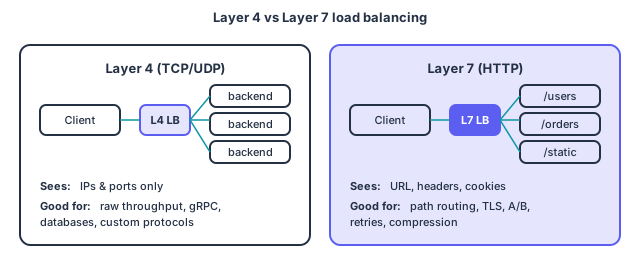
Layer 4 (transport / TCP, UDP). The LB sees only IPs and ports. It picks a backend, opens a connection, and shovels bytes. It does not parse the payload. Layer-4 balancers are fast, cheap, and protocol-agnostic — they can balance anything (databases, gRPC, custom binary protocols). Examples: AWS NLB, HAProxy in TCP mode, IPVS.
Layer 7 (application / HTTP). The LB parses the request. It can route by URL path, header, cookie, method, or body. It can terminate TLS, do compression, retry idempotent requests, and inject headers. Examples: AWS ALB, Nginx, Envoy, Cloudflare.
A useful rule of thumb:
- Reach for L4 when you need raw throughput or are balancing non-HTTP traffic.
- Reach for L7 when you want path-based routing, A/B testing, header-based feature flags, or any kind of request-aware logic.
Most real systems use both: an L4 LB at the edge for raw connection acceptance, an L7 LB inside the cluster for application routing.
Algorithms
Section titled “Algorithms”You will probably be asked to pick one and defend it.
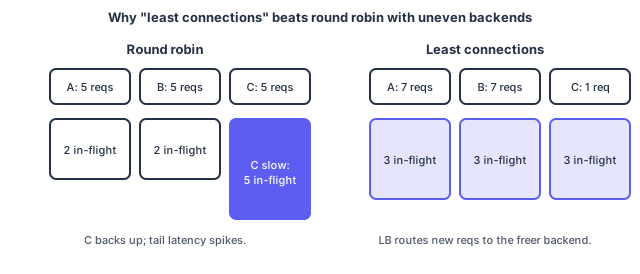
- Round robin. Send each new connection to the next backend in the ring. Simple, good when backends are interchangeable and requests are similar.
- Least connections. Send the next request to the backend with the fewest open connections. Better when requests have variable cost or backends have different capacity.
- Least response time. Combines least-connections with latency. Most effective when backends behave heterogeneously.
- Weighted variants. Assign each backend a weight (round robin, least connections). Use when running mixed instance sizes or canarying a new version.
- IP hash / consistent hash. Send all requests from the same client (or with the same key) to the same backend. Useful for in-memory caching on the backend or sticky session needs. See Consistent Hashing.
- Random with two choices (P2C). Pick two backends at random and send to whichever has fewer connections. Surprisingly close to least-connections at a fraction of the coordination cost.
In an interview, least connections is the safest default for application traffic; consistent hash is what you mention when you need cache locality or session affinity.
Health checks
Section titled “Health checks”A load balancer is only useful if it can detect and remove unhealthy backends. Two flavors:
- Active health checks. The LB periodically pings each backend (e.g.,
GET /healthz). Simple, works on quiet backends, but adds load. - Passive health checks. The LB watches real traffic — too many timeouts or 5xxs and the backend gets marked unhealthy. No extra load, but slower to react on low-traffic services.
Production setups usually combine the two. The key parameters to mention are:
- Interval — how often to check.
- Threshold — how many consecutive failures before marking unhealthy (and successes before marking healthy again).
- Timeout — how long to wait per check.
Healthy/unhealthy state should be slow to flip both ways so flapping backends do not whipsaw traffic.
Stickiness (session affinity)
Section titled “Stickiness (session affinity)”Sometimes you want all requests from a given user to land on the same backend — for example, when the backend keeps in-memory session state or a per-user cache. Options:
- Cookie-based. The LB sets a cookie on the first response identifying the backend; subsequent requests are routed accordingly.
- IP-based. Hash the client IP. Cheap, but breaks behind NAT and corporate proxies.
- Consistent hash on a request key. Route by user ID, session ID, etc.
Sticky sessions are a tax. They couple users to specific machines, hurt failover, and make rolling deploys harder. In an interview, prefer stateless backends with externalized session state (Redis, signed JWTs). Only reach for stickiness when the cost of externalizing state is genuinely higher than the cost of pinning.
Where the load balancer sits
Section titled “Where the load balancer sits”A typical, defensible diagram looks like this:
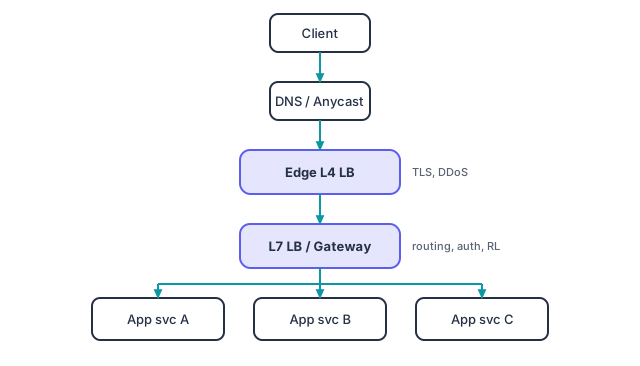
For internal service-to-service traffic, you’ll often have a second tier of L7 LBs (or a service mesh sidecar) inside the cluster. The same principles apply.
Common interview deep dives
Section titled “Common interview deep dives”How do you make the load balancer itself highly available?
A single LB is a single point of failure. Standard answers: run an active-active pair with floating IPs (keepalived/VRRP), use a managed LB whose control plane handles failover (ALB, GCLB), or run Anycast LB nodes so the network reroutes traffic when one node disappears.
What happens during a deploy?
The LB should drain connections from the backend being replaced — stop sending new requests but let existing ones finish for some grace period (15–60s typical). Combined with readiness probes, this avoids spilling errors during rolling deploys.
How do you handle a thundering herd of new connections?
L4 LBs can handle millions of connections; L7 LBs are usually the constraint. You can prewarm capacity, lean on connection-reuse (HTTP/2 multiplexing), and use queueing or rate limiting at the LB level to shed load gracefully rather than collapsing.
Can the LB cause hot spots?
Yes — especially with consistent-hash routing and skewed keys. The classic fix is to add virtual nodes so each backend handles many hash positions, smoothing the distribution.
What to say in an interview
Section titled “What to say in an interview”For most prompts, two sentences is enough:
“Clients hit an L4 edge LB that terminates TLS and forwards to a per-region L7 LB. The L7 LB routes by path to the right service and uses least-connections with passive health checks; sticky sessions are off because session state lives in Redis.”
The instant you reach for any non-default — consistent hashing, sticky sessions, weighted backends — pair it with the reason. The reason is what gets graded.